Gilgamesh

GILGAMESH (2021- 2024)
chamber opera for five singers, 11 instruments & electronics (140′)
libretto by Louis Garrick

premiered 28 September, 2024 by Sydney Chamber Opera, Opera Australia, Australian String Quartet & Ensemble Offspring at Carriageworks, Sydney

Conductor: Jack Symonds
Director: Kip Williams
Set Designer: Elizabeth Gadsby
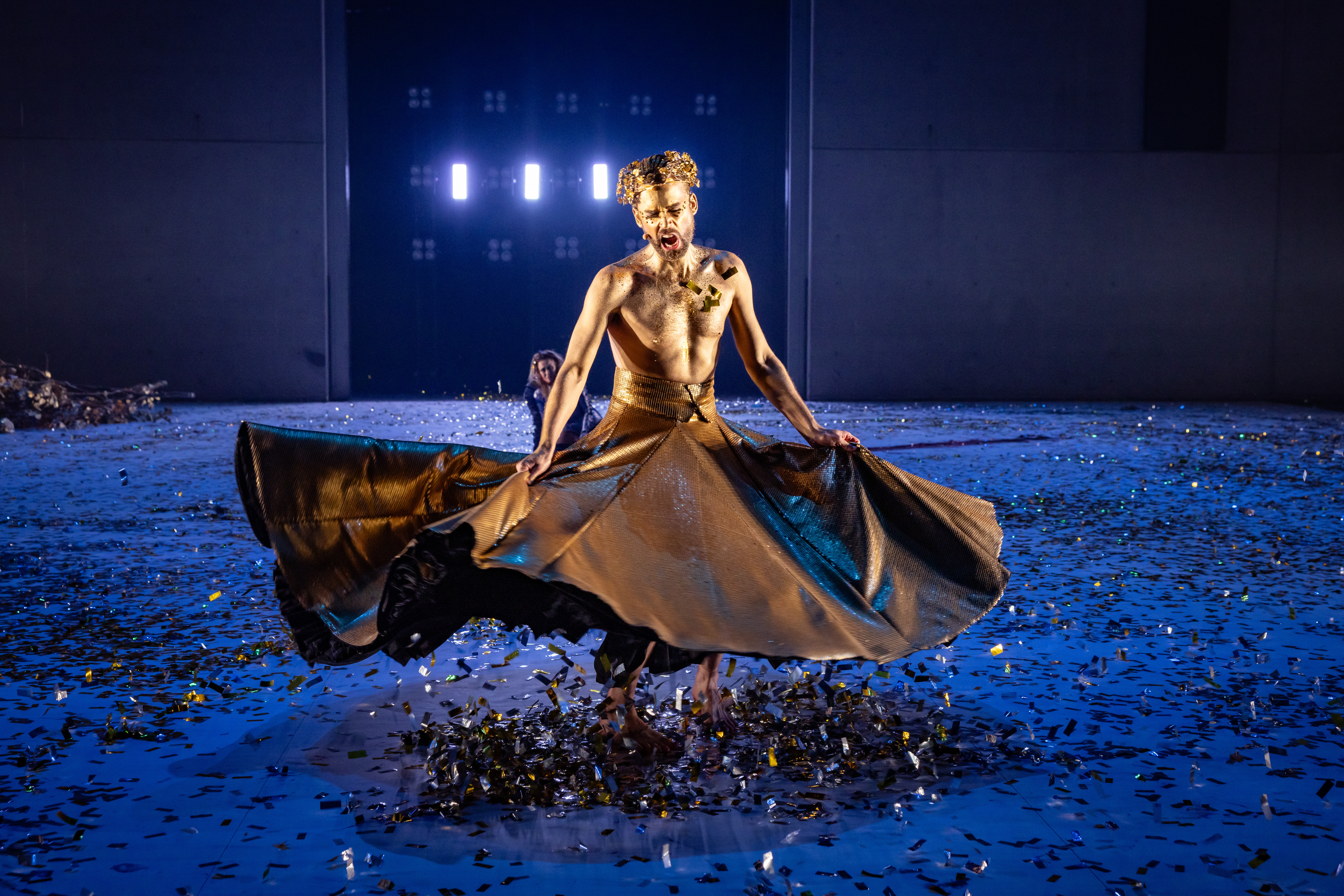
Costume Designer: David Fleischer
Lighting Designer: Amelia Lever-Davidson
Electronics Creation & Sound Designer: Benjamin Carey
Sound Designer: Bob Scott

Gilgamesh: Jeremy Kleeman
Enkidu: Mitchell Riley
Shamhat/ Uta-Napishti/ Scorpion: Jessica O’Donoghue
Ishtar/ Courtier/ Scorpion: Jane Sheldon
Humbaba/ Ur-Shanabi/ Courtier: Daniel Szesiong Todd

Australian String Quartet:

Dale Barltrop, Francesca Hiew: violins
Christopher Cartlidge: viola
Michael Dahlenburg: cello

Ensemble Offspring:

Lamorna Nightingale: flutes
Jason Noble: clarinets
Claire Edwardes: percussion
Jacob Abela: piano

Jasper Ly: oboe/cor anglais
Benjamin Ward: double bass
Melina van Leeuwen: harp

PROGRAM NOTE by Jack Symonds & Louis Garrick

In making an opera after the Epic of Gilgamesh, we follow the example of the Renaissance originators of the operatic art form. We explore an ancient text, uncovering all that speaks to us even thousands of years later, and we couch our reading in the musical and theatrical language of our times. 

Like all great epics, that of Gilgamesh (ca. 2100-1200 BCE) is about elemental forces: power, ambition, desire, anger, grief. While the sprawling, fragmentary text defies simple interpretation, what stood out to us in this, the original hero’s journey, was the narrative of a volatile young man who, through the experience of true love and the tragedy of losing it, gains maturity and self-awareness. It’s a relatable and very human story about the transformative power of love.

We have also taken a magnifying glass to Gilgamesh’s relationship with Enkidu. In Andrew George’s authoritative translation, there is talk of Gilgamesh “caressing” his friend and loving him “like a wife.” We found our hero’s apparent homosexuality essential to understanding his emotional journey. And isn’t it fascinating that same-sex attraction is arguably an aspect of the oldest written story humanity has?

At the same time, Gilgamesh is no ordinary person. As the ruler of what is usually considered the world’s first city, Gilgamesh is a symbol of civilisation and some of its worst eventualities: oppression, violence and environmental destruction. His ego-driven mentality leads only to catastrophe and it’s not until the damage is done, both personally and throughout Uruk, that he realises the error of his ways. Like the Epic, our opera ends with a question mark. Has Gilgamesh renounced his odious worldview for ever? Will he rebuild Uruk and be a kinder, more restrained leader? Or is it too little, too late? 

Every role was composed for the singers who premiered this opera, and their musical personalities and expressive proclivities have been encoded with love and admiration into the fabric of the score. Writing for the virtuosic combined forces of Australian String Quartet and Ensemble Offspring has meant that the instrumental lines have gained a complexity and detail quite different from those of an ‘Opera’ orchestra; each scene is focused around specific colours and notes which branch out like an arboreal system to encompass the enormous expressive shifts and character arcs in the Epic.

The Prelude holds the musical ‘potential’ of the whole opera – as Enkidu is created, so too is the world of harmony and timbral associations which will eventually form the mysteries and revelations several hours later. A whole Gilgamesh-specific musical grammar had to be made which could be capable of adapting, continuing, rejecting, renewing or reinventing the practices of almost half a millennium of operatic writing as needed by this extraordinary story. 

Balancing the mechanism and history of the genre (love duet, Triumphal Parade, arias of many kinds) with more extended vocalism, instrumental colour and electronic spatialisation is a fundamental part of the opera’s architecture. The addition of live electronics has allowed for a further layer of transformation: from the human to the fantastical/metahuman/eternal and back. Enkidu’s musical journey in particular begins with non-traditional vocal sound, synthesised with instrumental timbre, before being ‘humanised’ into learned singing.

SHOWREEL

String Quartet No. 2

(2021 – 2022)

Duration: c. 20 minutes

Commissioned by the Australian String Quartet for the London season of ANAM Quartetthaus through the Australian String Quartet Richard Divall Australian Music Fund

World premiere: 18 October, 2022, Adelaide Town Hall

Part One: an abnormality of growth

  1. Andante amoroso
  2. Scherzo I
  3. Scherzo II (in imitazione) – Trio (senza energia) – Scherzo II (con difetti)
  4. Finale I

Part Two: a continuity of paradoxes

  1. Adagio inquieto
  2. Scherzino interrotto
  3. Adagio stagnante
  4. Finale II
  5. Finale III

These two movements pursue similar material from radically different perspectives. The first begins with a wide-ranging cello melody ornamented with a quicksilver muted violin mapping out the same harmonic landscape again and again, providing most of the work’s content in embryonic form. This then calms down into a true slow movement. The ‘abnormalities’ of this Part refer to the quirk of the material growing too quickly for a ‘normal’ development of the structure, forcing the music to change into radically different forms and expressions. Scherzo I alternates violence and entropy in an unstable manner before coalescing into the strict canons of Scherzo II. The dissipation of energy in this Scherzo generates a true Trio section, struggling to regain direction. Its eventual resumption (‘with defects’) menacingly grinds the music into mechanistic repetition and dissolution. Finale I polyphonically grows the fragments of the opening cello melody in multiple directions simultaneously, eventually proliferating and accelerating out of control.

Part Two’s ‘continuity of paradoxes’ attempts to force together music built on irreconcilable differences. It begins with a dyad slowly ‘bleeding out’ into uncomfortable fragments of faster music. These become the dominant idea and prepare the way for another Scherzo, this one cut into by windows to wholly opposing material. When this spins itself to quizzical extinction, the piece finds its still, Adagio centre – but it proves too slow for ‘productive’ development. Nervous repeated-note twitches finally provide the key to opening Finale II, a do-over of Finale I from Part One but in a far slower tempo. Many of the developmental ‘problems’ of the original are given potential solutions, and the entropic and oppositional forces are reconciled. The key out of the quartet-labyrinth is a third Finale for this two-movement work, gathering together the piece’s entire material in a fast toccata which nonetheless gets stuck on loop: is it resolved, finished or simply gives up?

WATCH Australian String Quartet’s performance at the Sydney Opera House

https://stream.sydneyoperahouse.com/videos/australian-string-quartet-performs-jack-symonds-string-quartet-no-2

Music for violin and piano

STILL THE LIGHT BURNS (2013)

Duration: c. 9 minutes

1. Prelude

2. Hoquetus piangere

3. Canone rilassato

4. Cantabile instabile

5. Canone energico

6. In volo luminoso

Still the Light Burns is a sonata of interrelated movements dealing with music from my opera Climbing Toward Midnight. The title is taken from a line by the Expressionist poet Georg Trakl that forms the central dramatic panel in Act II of the opera. The musical phrase Kundry sings- “O how still the light burns”- forms the basis for all the movements’ variations whether sobbing, singing, flying or in various states of canon. 

The first movement is a prelude which launches the violin high, yet burns up very quickly. The ‘weeping hocket’ of the second movement sees the instruments completing each other’s drooping phrases while gradually gaining traction and momentum in knotted counterpoint. The two canons either side of the central slow movement are the identical in content, yet sharply contrasted in character. They summarise the work’s harmony as linear melody. The slow movement itself is a set of variations gradually revealing its latent origins in opera. The finale flies fast and canonic, pausing only to bring the first movement its long-awaited climax before a concluding headlong flourish. 

First performed 4 May 2013, The Rocks Windmill, Sydney by Doretta Balkizas & Jack Symonds

Listen to the complete work performed by Doretta Balkizas & Jack Symonds

FIVE POSTSCRIPTS (2013)

Duration: c. 5 minutes

Designed as a companion piece to Still the Light Burns, these miniatures are reflections of some of the larger piece’s musical concerns and obsessions.
The first is high and immobile, suspended in the air before a single fall and ascent which will be a feature of all the movements. The second is two simple gestures- a quick dialogue and a rhythmic disintegration. The third is a palindrome around a phrase from Zemlinsky’s rapturous opera Der Traumgörge where the central character asks the meaning of artistic beauty from a mirror. The fourth movement is a tiny mensuration canon which prefigures the final barcarolle- a last tribute to Henze gathering in all the other postscripts. 

First performed 26 March, ANAM, Melbourne by Doretta Balkizas & Jack Symonds

Listen to the complete work performed by Doretta Balkizas & Jack Symonds

Ein Fremder im fremden Land

Cello Sonata No. 1 (2013 – 2014)

Duration: c. 20 minutes

1. Two Preludes

2. Dialogue de l’ombre single

3. Adagio in Zemlinskys gebrochenes Handschrift

4. Una galleria di sette scherzi

5. Poesia rappresentativo

The title of this five-movement cello suite- ‘A stranger in a strange land’ comes from the text of Alexander Zemlinsky’s rapturous Lyric Symphony. The odd- numbered movements are portraits of Zemlinsky, his music and his aesthetics. The first movement is made of two contrasting preludes, one freely glittering in the top register and the other growing organically from the bottom. 

The second movement sees the cello and piano frustratingly unable to sound anything at the same time, constantly and inescapably taking it in turns to find a way through an unstable labyrinth of gestures. The ‘single shadow’ of the title refers to my very un-Boulezian attempt to refrain from polyphony and maintain the illusion of just one highly eccentric line being performed. 

The third movement is an imaginary scene where all the major works of Zemlinsky’s prime period- from the Maeterlinck songs through the two Expressionist operas, second String Quartet and Lyric Symphony- are swirling around in his head. His ‘broken handwriting’ barely holds together this plangent cornucopia of ideas.

Next, the fourth movement is a ‘gallery’ of seven scherzi, each a variation on a single chord. They are miniaturised yet incomplete, always requiring the next scherzo to ‘finish’. Several are newly distorted versions of other music in the piece, though the floating final scherzo leads directly into the fifth movement. The heading on this finale is ‘My lamp to light your way’, the final line of the Lyric Symphony. Here I imagine the cello’s continuous song finding repose and possibly the smallest comfort after the difficulties of the rest of the piece. 

Commissioned by Timo-Veikko Valve

Listen to the complete work performed by Timo-Veikko Valve & Jack Symonds

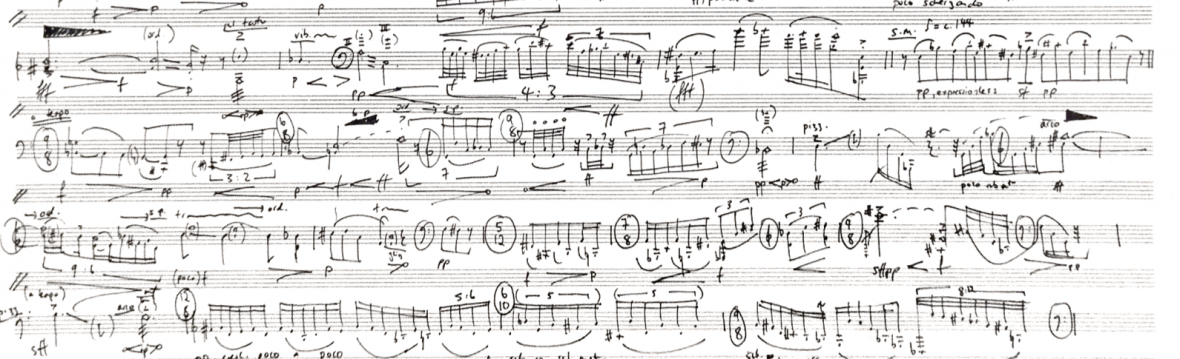
Score samples here

thick with garbage and the dust of stars

Trakl-Pictures for String Quartet (2013)

Duration: c. 14 minutes

The four unequal movements of this string quartet are snapshots from the lurid poetry of Austrian Expressionist Georg Trakl.

The first two movements are fragments; question marks. The first is a slow swirl of uncertainty, the second a warped descent. The third movement is fast, and obsesses over hard scraps of theme with the gears constantly shifting. The fourth movement is a numbed night-vision which looks up at a cold sky and sees the rest of the piece disappear out of sight.

Commissioned by Carriageworks

First performance: 17 August 2013, Carriageworks, Sydney by the JACK Quartet

Listen to the premiere performance by the JACK Quartet

View the complete score here

2 Rilke Lieder

for soprano, viola/viola d’amore & clarinet (2014)

Duration: c. 9 minutes

Rilke’s Die Engel and Lösch mir die Augen aus are two poems which display his visionary conception of the spiritual and of love.

In Die Engel, the five movements of the composition cut across Rilke’s text overlaying a new structure on his mystical evocation of a terrifying angel. The ‘Alpha-and-Omega’ quality of this figure is here represented by palindromes both exact and inexact. The outer movements are exact palindromes, the second and fourth fast movements are gestural palindromic variations, and the central slow movement contains palindromic interval shapes.

In contrast, Liebeslied fanatically dissects Rilke’s extraordinary nine-line evocation of a love so powerful it can transcend the body into a nine-part form made of collections of genre pieces, each colouring a single line. First come a series of four variations on a chord, widening the expressive extreme until almost breaking. Next is a pair of Hommages- the first is to Salvatore Sciarrino, where the ‘breaking’ is here achieved with his characteristic splintered quietude. Next is a genuflection to Hans Werner Henze- describing hands and hearts-, which strings together tiny splinters from some of his most rapturous passages. Finally, three quick canons all run together, contorting themselves in increasingly complex contrapuntal formations until a canon at the unison ties an open-ended knot. 

Commissioned by Jane Sheldon for performance at her first Symbiosis Concert, 18 July 2014

Die Engel
Liebeslied

Performed by Jane Sheldon (soprano), James Wannan (viola/ viola d’amore) and Jason Noble (clarinet)

Score sample here

Decadent Purity

for viola d’amore and ensemble (11 players)

Duration: c. 28 minutes

“Could this have been love? Grant it to be one form of love, for even though at first glance it seemed to retain its pristine form forever, simply repeating that form over and over again, it too had its own unique sort of debasement and decay. And it was a debasement more evil than that of any normal kind of love. Indeed, of all the kinds of decay in this world, decadent purity is the most malignant.”
Yukio Mishima, Confessions of a Mask

The seven movements of this concerto explore the shifting weights of fanatical obsession and desire. The first and sixth simply investigate how we hear the sacred construction of a scale, the second, fourth and seventh deal with the accrual and dispersal of unstable energy and the third and fifth are interior slow movements reaching back to a curdled and disappeared romanticism.
The centre, mostly hidden, is the solo viola d’amore’s tuning of its 7 strings to a chord of D minor. Every other process tries to disrupt and desecrate the natural harmonic construction of this ancient instrument. The ensemble acts like a modern mirror, offering the viola d’amore an at-times unkind reflection of its material. The soloist’s relationship with the surrounding ensemble isn’t combative: they often amplify and extend the feelings and thoughts of the soloist, and occasionally present an entirely opposite direction and alternative path. 

First performance: Bendigo International Festival of Experimental Music, James Wannan (viola d’amore), Argonaut Ensemble conducted by Jack Symonds

Listen to the recording of the world premiere

View the complete score here

Guardare, meravigliarsi…

Five nocturnes for solo piano (2021)

Duration: c. 17.5 minutes (2’30” + 4’30” + 3’30” + 3’30” + 3’30”)

Guardare, meravigliarsi… is a collection of five nocturnes, each of which attempts to create the illusion of a multiplicity of layers within a single instrument. The title is from a recurring libretto line and musical figure in Luigi Dallapiccola’s major opera Ulisse: “Guardare, meravigliarsi, e tornar a guardare” (‘to gaze, to marvel, and to return to gazing”), representing the questing, visionary spirit of Ulysses, as well as being a metaphor for the process of composition itself. 

1. Notturno sospeso: a rising figure separates the registers of the keyboard into something like a ‘sky’ and a ‘sea’, with a ‘suspended’ melody poised to dip downwards at any moment. 

2. Notturno in riflessione: one single melody is ‘reflected’ softly into the middle register; a world of mirrors where every figure is sometimes exactly imitated and at others distorted.

3. Notturno ghiacciato: A slow, 3-part canon ‘freezes’ into a landscape of widely-spaced chords from which tendrils of the opening almost succeed in escaping.

4. Notturno in ommagio: The opening bar of Gabriel Fauré’s mysterious final Nocturne slips into a hommage-commentary on Fauré’s own pianistic world, before atomising into a wild middle section of keyboard extremes. The return of the Fauré material extinguishes into silence.

5. Notturno corrente: ‘Flowing’ from one idea to the next, this nocturne takes the material of the other four and creates continuity. Its final slow section is a commentary on the phrase from Dallapiccola, finding an uneasy repose somewhere between his harmonic practice and my own.

These nocturnes may be played individually or in any combination/ shorter sequence, however if Nocturne No. 5 is performed, it must always be played last.

Some suggested alternative orders:

2, 4, 5
4, 1, 5
3, 5
1, 4, 2
1, 3, 4, 5

Listen to Jack Symonds perform the complete work

Score samples here

Memory

for flute and five musicians (2019 – 2020)

Duration: c. 19 minutes

This flute concerto burrows into the processes of remembering. How can music ‘remember’ – other people, other notes? The first movement is a decayed memory of the opening of Allan Pettersson’s Thirteenth Symphony, a work of extreme instability and energetic violence seen from afar, after time has perhaps erased much of its anger – what is left?

The central movement creates a representation of ‘Damnatio Memoriae’ – a purging from society’s collective memory, or a rewriting of history. A series of variations progressively have their musical ‘identities’ erased by a repeating gesture that attempts to extinguish the soloist – here cast as an antagonist to be purged from the landscape.

The final movement considers the Hapax – something that only occurs once in a work. Would we recognise and remember if it we heard it? Curlicues of bass flute melody infold themselves in a hall of mirrors where all events are reflected and repeated except one – the key to unlocking the piece. 

Memory was commissioned by Ensemble Offspring

First performance: 28 October 2021, Sydney Opera House Utzon Room by Lamorna Nightingale (flutes) with Ensemble Offspring (Jason Noble, Thibaud Pavlovic-Hobba, Chris Pidcock, Ben Kopp & Claire Edwardes) conducted by Jack Symonds

Movement I
Movement II
Movement III

Listen to the work performed by Lamorna Nightingale, Ensemble Offspring cond. Jack Symonds

View the complete score here

Blühen

for soprano, piano and string sextet (2020 – 2021)

Duration: c. 12 minutes

This song cycle is a portrait of the German fin-de-siècle poet Richard Dehmel. Lines and stanzas from five of Dehmel’s poems are woven together to give glimpses of a world vision which trembles on the brink of Expressionism, seeped through with an mystical, weary Romanticism. I have attempted to create a continuity of image from the storms of desire (Ansturm) through the haunted, nocturnal ‘blossoming’ of death-soaked flowers (Maiblumen blühten überall), a gnomic vision of a lonely, inhuman place (Aufblick) leading to a chilling apparition (Erwartung) and finally, the ambiguous horror of true recognition (Die stille Stadt). 

Blühen is commissioned by the Adelaide Festival of Arts and the Elder Conservatorium of Music, University of Adelaide as recipient of the John Bishop Memorial Commission 2020.

First performance: 5 March, 2021 UKARIA, Adelaide Festival by Jessica Aszodi (soprano), Jack Symonds (piano), Australian String Quartet, James Wannan & Blair Harris

Listen to Blühen performed by Jessica Aszodi (soprano), Jack Symonds (piano), Australian String Quartet, James Wannan & Blair Harris

View the complete score here