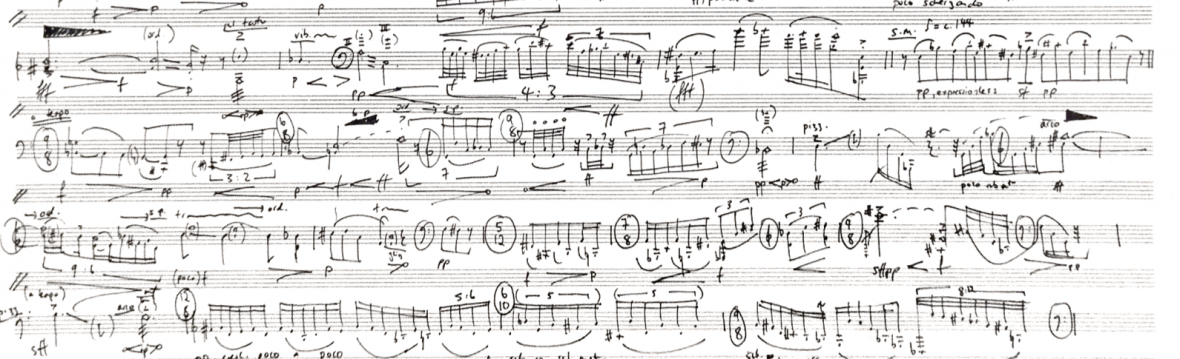
Music for violin and piano

STILL THE LIGHT BURNS (2013)

Duration: c. 9 minutes

1. Prelude

2. Hoquetus piangere

3. Canone rilassato

4. Cantabile instabile

5. Canone energico

6. In volo luminoso

Still the Light Burns is a sonata of interrelated movements dealing with music from my opera Climbing Toward Midnight. The title is taken from a line by the Expressionist poet Georg Trakl that forms the central dramatic panel in Act II of the opera. The musical phrase Kundry sings- “O how still the light burns”- forms the basis for all the movements’ variations whether sobbing, singing, flying or in various states of canon. 

The first movement is a prelude which launches the violin high, yet burns up very quickly. The ‘weeping hocket’ of the second movement sees the instruments completing each other’s drooping phrases while gradually gaining traction and momentum in knotted counterpoint. The two canons either side of the central slow movement are the identical in content, yet sharply contrasted in character. They summarise the work’s harmony as linear melody. The slow movement itself is a set of variations gradually revealing its latent origins in opera. The finale flies fast and canonic, pausing only to bring the first movement its long-awaited climax before a concluding headlong flourish. 

First performed 4 May 2013, The Rocks Windmill, Sydney by Doretta Balkizas & Jack Symonds

Listen to the complete work performed by Doretta Balkizas & Jack Symonds

FIVE POSTSCRIPTS (2013)

Duration: c. 5 minutes

Designed as a companion piece to Still the Light Burns, these miniatures are reflections of some of the larger piece’s musical concerns and obsessions.
The first is high and immobile, suspended in the air before a single fall and ascent which will be a feature of all the movements. The second is two simple gestures- a quick dialogue and a rhythmic disintegration. The third is a palindrome around a phrase from Zemlinsky’s rapturous opera Der Traumgörge where the central character asks the meaning of artistic beauty from a mirror. The fourth movement is a tiny mensuration canon which prefigures the final barcarolle- a last tribute to Henze gathering in all the other postscripts. 

First performed 26 March, ANAM, Melbourne by Doretta Balkizas & Jack Symonds

Listen to the complete work performed by Doretta Balkizas & Jack Symonds

Ein Fremder im fremden Land

Cello Sonata No. 1 (2013 – 2014)

Duration: c. 20 minutes

1. Two Preludes

2. Dialogue de l’ombre single

3. Adagio in Zemlinskys gebrochenes Handschrift

4. Una galleria di sette scherzi

5. Poesia rappresentativo

The title of this five-movement cello suite- ‘A stranger in a strange land’ comes from the text of Alexander Zemlinsky’s rapturous Lyric Symphony. The odd- numbered movements are portraits of Zemlinsky, his music and his aesthetics. The first movement is made of two contrasting preludes, one freely glittering in the top register and the other growing organically from the bottom. 

The second movement sees the cello and piano frustratingly unable to sound anything at the same time, constantly and inescapably taking it in turns to find a way through an unstable labyrinth of gestures. The ‘single shadow’ of the title refers to my very un-Boulezian attempt to refrain from polyphony and maintain the illusion of just one highly eccentric line being performed. 

The third movement is an imaginary scene where all the major works of Zemlinsky’s prime period- from the Maeterlinck songs through the two Expressionist operas, second String Quartet and Lyric Symphony- are swirling around in his head. His ‘broken handwriting’ barely holds together this plangent cornucopia of ideas.

Next, the fourth movement is a ‘gallery’ of seven scherzi, each a variation on a single chord. They are miniaturised yet incomplete, always requiring the next scherzo to ‘finish’. Several are newly distorted versions of other music in the piece, though the floating final scherzo leads directly into the fifth movement. The heading on this finale is ‘My lamp to light your way’, the final line of the Lyric Symphony. Here I imagine the cello’s continuous song finding repose and possibly the smallest comfort after the difficulties of the rest of the piece. 

Commissioned by Timo-Veikko Valve

Listen to the complete work performed by Timo-Veikko Valve & Jack Symonds

Score samples here

À la recherche d’Eden perdu

Cello Sonata No. 2 (2021)

Duration: c. 17 mins

  1. Eau vivante
  2. Intermède (Purgatoire)
  3. Entre les jardins du paradis et de l’enfer

This sonata attempts a détente with the artistic world of Paris, circa WWI.  The first movement deals with Gabriel Fauré’s late song Eau vivante from La chanson d’Ève: a miracle of unstable continuity. In Fauré, a constantly refreshed single line weaves through the piano beneath an unbroken surface of delicate harmony: a perfected vision of water in the Garden of Eden.

Eau vivante is an attempt to analyse, synthesise and dip into this spring of harmony, yet is in a process of constant failure. I find it fascinating when a series of musical events which achieve a harmonious result in Fauré can be run aground, taken to extremes and led into impossible dead-ends. I have tried, more than a century later, to reconstruct the rarefied atmosphere conjured by the isolated, near-deaf Fauré at the turn of the 20th Century. Can we really dream of an untrammelled natural world in 2021?

If this movement is a thwarted, unreachable heaven, the second movement is a short, paralysed Purgatory, effortfully going nowhere.

The last movement attempts a more Proustian synthesis between remembered images of heaven and hell, initially presented strictly in alternation but the one continually bleeding into the other to form an unholy, messy reality. Bacchanals, bells and an unexpected berceuse transform dying embers of Fauré-memory and purgatorial inertia into an uneasy repose.


The complete work is commissioned by Kim Williams AM for Blair Harris.

Eau vivante is commissioned by the Australian National Academy of Music (ANAM) as part The ANAM Set (2021), written for Oliver Russell and given its world premiere on 30 October 2021 at the Abbotsford Convent, Melbourne. The ANAM Set was funded by the Restart Investment to Sustain and Expand (RISE) Fund – an Australian Government Initiative.

Listen to the first movement, Eau vivante recorded at ANAM by Oliver Russell and Leigh Harrold